How to Make a Videcall on Messenger
How to Make a Video Call on Messenger: open the app or Messenger.com, choose the person or group chat, then tap or click the video camera icon in the chat header. If the call will not start, check sign-in status, camera permission, microphone permission, and your internet connection before changing anything else.
Key takeaways
- Open the chat first, then tap the video camera icon to start the call.
- Camera, microphone, and internet permissions are the usual blockers.
- Messenger works on iPhone, Android, and Messenger.com with similar call controls.
- Group calls are easiest inside an existing thread, but extra members may join if the chat is old.
- If video or sound fails, check browser or app permissions before retrying.
What Messenger video calling is and what you need first
Video calling lives inside an existing chat, not in your phone’s regular dialer. Meta describes its messaging service as a way to connect across devices alongside Facebook, Instagram, and Meta AI Messenger from Meta. In practice, that means you call from a conversation thread tied to your account, not from a phone number keypad.
You can place video calls from the iPhone app, the Android app, or a desktop browser at the official web version. In the U.S. App Store, the iPhone listing describes it as a free app for connecting with friends and family on Facebook and the chat service without needing a phone number App Store.
Minimum setup checklist
Use this setup checklist before you call: confirm you are signed in, open the exact conversation you want, allow camera and microphone access, use a stable Wi-Fi or cellular connection, and keep the app updated. On Android, install or update it through Google Play under Meta Platforms, Inc. to avoid unofficial copies Google Play.
Look inside the conversation, not in the Phone app, FaceTime, or your contact list. The video control is usually near the top of the chat beside the voice call icon or the person’s name. If the top bar is hidden, tap once near the top of the conversation, scroll back to the latest messages, or open the contact details area from the chat header.
How to make a video call on Messenger step by step
You can start a video call in less than a minute when you open the correct chat and choose the camera icon rather than the voice call button. The basic flow is the same on iPhone, Android, and desktop, but the location of the control can shift after app updates, screen-size changes, or browser zoom settings.
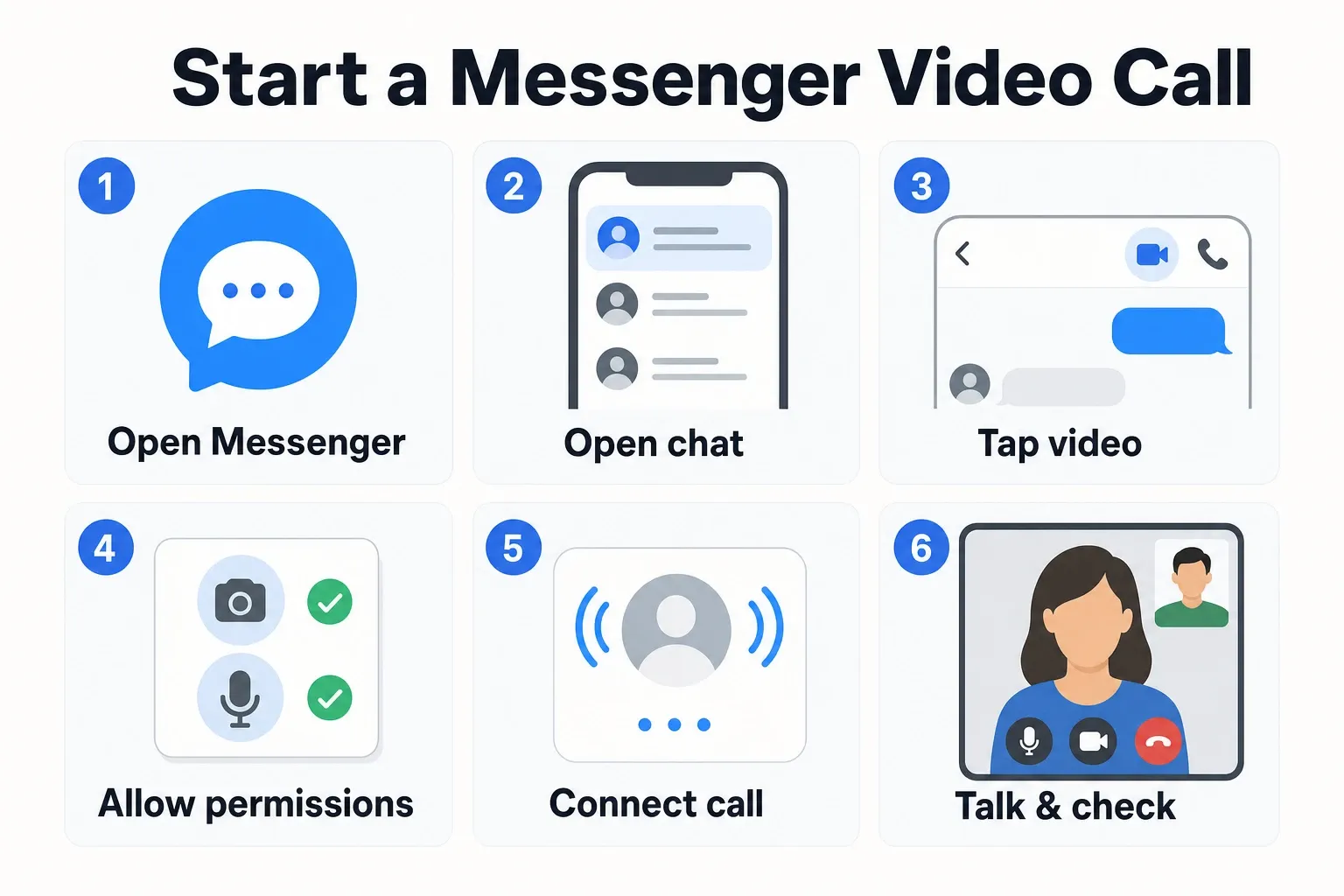
- On iPhone, open the Messenger app, sign in if asked, and tap the Chats tab if you are not already there.
- Tap the conversation with the person you want to call. For a new contact, use Search to find the person or open the Facebook-connected thread already in your inbox.
- Tap the video camera icon near the top of the chat. If iOS asks for camera or microphone access, allow it so the other person can see and hear you.
- Wait for the other person to answer. While the call is ringing, keep the app open and avoid switching to a weak network, such as a far corner of the house with poor Wi-Fi.
- On Android, open the Messenger app, choose the chat, and tap the video camera icon in the conversation header. If Android shows a permission prompt, choose the option that allows Messenger to use the camera and microphone.
- To call from a desktop browser, go to Messenger.com, sign in with your Facebook or Messenger account, open the conversation, and select the video call control in the chat window.
- If your browser asks for permission, allow camera and microphone access for Messenger.com. If you accidentally block access, the call may connect with no video or no sound.
- To start a group video call, open an existing group chat and tap or click the video camera icon. Everyone in that group thread may be able to join from the call prompt or conversation.
- To add someone during an active call, look for the invite, add people, or participants control inside the call screen. The exact label can vary by app version, so use the icon that shows people or a plus sign.
- Use the in-call controls to mute your microphone, turn your camera on or off, switch cameras on mobile, invite others, or end the call. The red phone button ends the call; the microphone button mutes only your audio.
One-to-one calls versus group calls
For a one-to-one call, open the direct message with that person and start from the chat header. For a group call, open the existing group thread first and check the member list before calling. That quick check matters if you reuse old family, class, or neighborhood chats where extra people may still be included.
Group calls are most convenient when everyone you need is already in the same thread. They are a poor fit when the group is outdated, mixed with work and personal contacts, or includes someone who should not receive a call notification. In those cases, create a new group chat first or call people one at a time.
Best benefits of using Messenger for video calls
Best benefits: the strongest advantage is low setup friction for people already using Facebook-linked chats. The trade-off is that the other person needs access to the same chat account and an internet connection. This is useful for a quick parent check-in, a last-minute plan change, or a short call where sending a meeting link would be overkill App Store.
- Free app access: Messenger is free to download, and starting a video call does not require buying a separate calling subscription inside the app.
- Cross-device flexibility: one person can use an iPhone while another answers from Android or a desktop browser, which helps when family members use different devices.
- Fast casual calling: it works well for quick catch-ups, family chats, and “are you free?” conversations that begin as text messages.
- Facebook contact convenience: if the person is already in your Facebook or Messenger conversation list, you do not need to ask for a phone number just to start a call.
- Low setup friction: the call begins from a message thread, so there is no separate meeting room to create for everyday conversations.
Rates, fees, and feature limits to know
Rates and fees: Meta does not charge a separate per-call fee for video calls through the app, but the call still uses internet access. On home Wi-Fi, the cost is usually part of your regular broadband bill. On cellular data, usage can count against your wireless plan, and your carrier’s speed limits or overage rules control what happens after you hit your plan threshold.
| Cost or limit | What it means for U.S. users | Practical takeaway |
|---|---|---|
| App price | The iPhone listing presents Messenger as a free messaging app App Store. | Downloading the app is not the same as paying for a calling plan; check your Apple ID only for optional purchases or unrelated charges. |
| Android access | Messenger is available from Google Play under Meta Platforms, Inc. Google Play. | Install updates from Google Play instead of a random download link, especially if calls fail after an old app version. |
| Web access | Messenger.com works in a desktop browser after sign-in Messenger.com. | A laptop can be the better choice for long calls because it has a larger screen and can stay plugged in. |
| Network costs | Video uses an internet connection, even when the app itself is free. | Use Wi-Fi for long calls if your wireless plan has limited high-speed data. |
| Permission limits | Camera and microphone access must be allowed at the device or browser level. | If the other person can hear but not see you, check permissions before reinstalling the app. |
| Call stability | Video quality depends on connection strength, device performance, and service availability. | If the picture freezes, test another network or switch to audio before assuming Messenger is broken. |
Free calling versus real usage cost
For cellular calls, check data controls before a long conversation. On iPhone, open Settings, Cellular, and review whether the app is allowed to use mobile data. On many Android phones, open Settings, Network & internet, then SIMs or Data usage to review app data access. Labels differ by manufacturer, so use the Settings search box for “data usage” if you cannot find it.
For a long or important call, use the strongest connection available and plug in the device if the battery is low. Video calling uses the camera, screen, microphone, speaker, and network connection at the same time. A phone at 8% battery, a crowded public Wi-Fi network, or a weak cellular signal can make a working app look broken.
Common problems, fixes, and when not to use Messenger video calls
Troubleshooting should move from the device outward. Most failures come from blocked camera or microphone access, an outdated app, an unstable connection, a browser setting, or a wider service problem. Start with the fastest local checks, then test whether the issue follows your account, your device, or the service itself.
Camera or microphone is blocked
If the call connects but your video is black, your face never appears, or the other person cannot hear you, check permissions first. On iPhone, open Settings, find the app, and allow Camera and Microphone. On Android, open Settings, Apps, the app name, Permissions, then allow Camera and Microphone.
On desktop, browser permission is just as important as the website. If you previously clicked “Block” on a camera or microphone prompt at the official web version, the browser may remember that choice. Open the site settings for that page, allow camera and microphone access, then reload the conversation before trying again.
The app is outdated or glitching
If the video button disappears, the app crashes, or calls ring but never open, check for an update in the App Store or Google Play before deleting anything. Updating keeps the account and local settings in place. Reinstalling can help later, but it may also require a fresh sign-in and new permission prompts.
If the app is already current, close it fully and reopen it. On mobile, also close other apps that may be using the camera, such as a video meeting app or the default camera app. Then return to the chat and try the call again so only one app is requesting camera access.
The connection is weak
Frozen faces, delayed audio, and constant reconnecting usually point to the network rather than the call button. Move closer to your router, disconnect a VPN if pages are loading slowly, or switch between Wi-Fi and cellular data. If Wi-Fi fails but cellular works, your home network is the likely problem.
Run two quick comparison tests before changing more settings. First, send a normal text message or photo in the same chat. If it is delayed too, the problem is broader than video. Second, try a different chat with a trusted contact. If one conversation fails but another works, the issue may be tied to that thread, contact, or group.
Messenger may be having an outage
Is it your device or a Messenger outage? Test another chat, then another device or browser signed in to the same account. Check the App Store or Google Play for updates. If calls fail across devices or several contacts report the same problem, check service reports before changing settings again. Downdetector shows real-time reports for Facebook Messenger problems, including sending and reading issues Downdetector.
Who this is best for: use the app for everyday personal calls where convenience matters more than formal scheduling. It is less ideal for a job interview, telehealth appointment, school meeting, legal call, or urgent family situation where a dropped connection would cause real problems. For those, use the platform the organizer requested or keep a regular phone call ready as backup.
Messenger feature comparison and useful contacts
Device comparison table: Column headings are Fastest path, Where the video button appears, Most common permission issue, and Use this option when. iPhone: open the app, choose the chat, tap the camera icon; the button is usually in the top chat header; iOS Camera or Microphone permission is off; use it when you already use the iPhone app and want a mobile call.
Android: open the app, choose the chat, tap the camera icon; the button is usually beside the voice call control near the top; Android app permission is denied or the app is outdated; use it when your phone is managed through Google Play.
Desktop browser: go to the official web version, open the conversation, click the camera icon; the button appears in the conversation header; the browser has blocked camera or microphone access; use it when you want a larger screen, a keyboard, or easier multitasking.
| Entry point | Setup friction | Where the video call starts | Common permission issue | Best use case | Official source |
|---|---|---|---|---|---|
| iPhone Messenger app | Low if Messenger is already installed and signed in | Open a chat, then tap the video camera icon in the chat header | iOS may block camera or microphone access until allowed in Settings | Calling friends or family from an iPhone without asking for a phone number | App Store |
| Android Messenger app | Low if installed or updated through Google Play | Open the conversation, then use the video camera icon near the top of the thread | Android app permissions may be denied or set to ask every time | Mobile-first calling on Samsung, Google Pixel, Motorola, and other Android phones | Google Play |
| Desktop web at Messenger.com | Medium because the browser must allow camera and microphone access | Open a conversation at Messenger.com, then select the video call control | Browser site settings can block camera or microphone even when the laptop hardware works | Longer calls from a desk, larger screen viewing, or troubleshooting when the phone app fails | Messenger.com |
Useful contacts and official pages
Useful contacts and safe links: use the official web version for browser calls, Meta’s product page for service information, the App Store for iPhone updates, and Google Play for Android updates. Keeping the official links close helps you avoid fake apps, old help pages, and unofficial downloads. Meta’s page also links the service to related products, including Facebook, Instagram, and Meta AI Messenger from Meta.
- Messenger.com: use it for desktop web calling and to confirm whether your account works outside the mobile app.
- Meta’s Messenger page: use it to understand Messenger as part of Meta’s current product family.
- App Store: use it to install or update Messenger on iPhone in the United States.
- Google Play: use it to install or update Messenger on Android devices.
- Downdetector: use it as a quick outside check when Messenger calls, messages, or logins appear to fail for more than one person.
Next steps
- Pick your device: iPhone app, Android app, or Messenger.com on desktop.
- Open the exact Messenger chat for the person or group you want to reach.
- Tap or click the video camera icon and allow camera and microphone access if prompted.
- If the call fails, test permissions, update the app, switch networks, then check Downdetector.
- For high-stakes calls, have a backup option ready before the scheduled time.
Frequently asked questions
Do I need a phone number to video call someone on Messenger?
FAQ: Do I need a phone number to make a video call? No. Calls work through a Facebook-linked chat account, so you do not use a phone number as the caller ID. Open the person’s existing message thread and tap the video camera icon. If you cannot find the person, search by name inside the app rather than opening your phone’s contacts first.
Can I make a group video call on Messenger?
FAQ: Can I make a group video call? Yes. Open an existing group chat and tap the video camera icon to call that group. Before you start, review the members so you do not notify an old roommate, former coworker, or extra relative who still appears in the thread. If the wrong people are listed, create a fresh group chat.
Is Messenger video calling free?
FAQ: Is a video call free? The feature itself has no separate per-call fee, and the app is free to download from the official stores. Your internet connection still matters. Wi-Fi usually uses your home internet plan, while cellular calls can count against mobile data and may slow down if your wireless plan has a high-speed data limit.
Why is my Messenger video call not connecting?
FAQ: Why is the video call not working? The most common causes are denied camera or microphone access, weak Wi-Fi or cellular signal, an outdated app, a browser block, sign-in trouble, or a temporary service issue. Check permissions, update the app, test another chat, try another device or browser, and then look at service-status reports if failures continue.
Can I use Messenger video calls on a computer?
FAQ: Can I make a video call from a computer? Yes. Go to the official web version in a desktop browser, sign in, open the conversation, and click the video camera icon in the chat header. If the call opens without sound or video, allow camera and microphone access in the browser’s site settings and reload the page.
How we researched this
Sources consulted for this article: